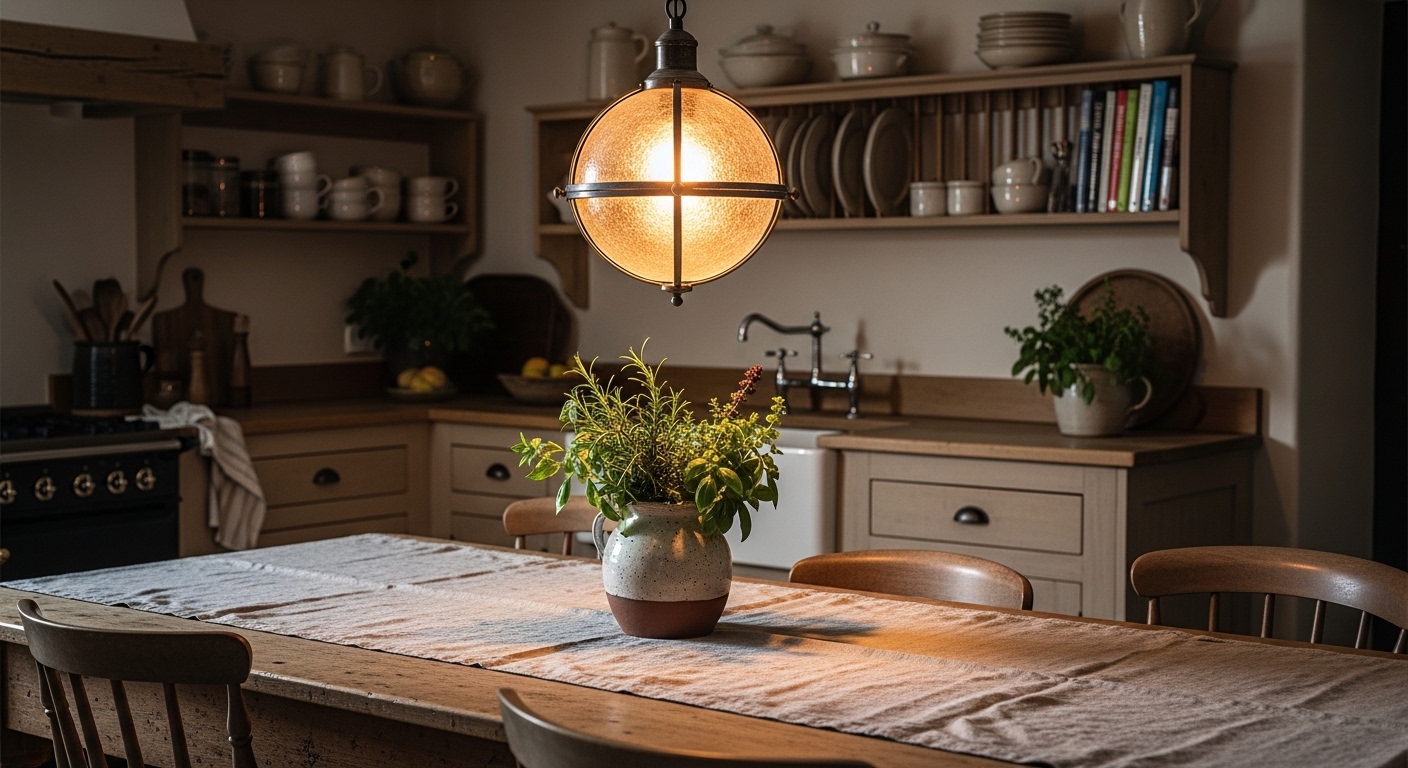
Cozy Atmosphere
The best dimmable LED bulb for a cozy home is a dim-to-warm bulb, which gets warmer in colour as you turn it down, the way an old incandescent did. Philips Warm Glow is the one I would buy first: an 8 watt A19 at 800 lumens with a 95 CRI, dimming from 2700K down to 2200K, listed at about $3 a bulb in a two-pack. For a brighter bulb with excellent colour, Cree's 90+ CRI dimmable A19 is the pick, and for a visible bulb, Feit's vintage filament ST19. Here is why dim-to-warm matters and how to stop the flicker.
When I started replacing every harsh overhead light in our cottage, I noticed something odd. An ordinary LED at 2700K stays 2700K as you dim it. It just gets darker. An incandescent bulb did something different: as it dimmed, it turned more amber, closer to candlelight. That shift is a big part of why an old lamp on low felt cozy and a dimmed LED can feel grey and a little sad.
Dim-to-warm bulbs copy that. At full brightness they are a normal warm white; turned down, they drift towards 2200K or lower. In the evening, in a room full of linen and wood, it is the difference between lit and glowing. I wrote about that candle-like quality in the candlelit feeling with electric light.
| Bulb | Lumens | Colour | CRI | Price seen |
|---|---|---|---|---|
| Philips Warm Glow 8W A19 | 800 | Dims 2700K to 2200K | 95 | about $3.19 per bulb in a two-pack |
| Philips Warm Glow 8W A19, 90 CRI | 800 | Dim-to-warm | 90 | about $4.29 each |
| Cree 100W-equivalent A19 | 1,600 | 2700K | 90+ | about $12.44 at Walmart |
| Feit ST19 8.8W filament | 800 | 2700K | 90 | See retailer |
| GE Reveal HD+ | Varies by bulb | Reveal tint | High (not stated) | See retailer |
Warm Glow is Philips' dim-to-warm line, and the 8 watt A19 is the everyday bulb for table and floor lamps. Bulbs.com lists it at 800 lumens with a 95 CRI, dimming from 2700K at full brightness to 2200K turned down, and a two-pack at $6.38. A 90 CRI version of the same bulb was listed at $4.29 each.
At full brightness it looks like any good warm LED. The magic happens on the dimmer: by the time the lamp is low for the evening, it has the amber glow of an old incandescent. Warm Glow comes in other shapes too, including candelabra and floodlight bulbs, so you can keep a whole room consistent.
My note: put these in every lamp you use after dinner. It is the cheapest way to make a room feel softer.
When I need real light, in the kitchen or over my writing desk, I want a bulb with excellent colour, and Cree's 90+ CRI bulbs are the ones I would choose. The 100 watt equivalent A19 is listed at 1,600 lumens, 2700K, 90+ CRI and dimmable, at about $12.44. It is not dim-to-warm, so it stays 2700K as you dim, but its colour quality makes wood and fabric look right at any level.
Check the CRI on the box: one Cree 60W-equivalent listing showed CRI 80, so not every Cree bulb is the high-CRI version.
For bare-bulb pendants and lamps where the bulb is part of the look, Feit's ST19 vintage filament bulb gives 800 lumens at 2700K with a 90 CRI, dims, and is rated for enclosed and damp fixtures, per Feit's listing. It is clear glass with straight filaments, so it looks like an old Edison bulb but lights like a modern one. It is the bulb I would use in a glass pendant where you see everything.
GE's Reveal line is designed to make colours and whites look crisper, and the HD+ bulbs are dimmable. Listings vary widely, with one 40 watt replacement shown at 240 lumens and another at 350, so check the exact box. GE does not publish a CRI number in the listings I saw. Reveal suits a bathroom or a laundry room where you want whites to look white, more than a cozy living room.
Almost every dimmable LED problem comes from the dimmer. Older dimmers were designed for incandescent bulbs, which draw far more power, and they can make LEDs flicker, buzz or drop out at the bottom of the range.
I explain why dimmers are the foundation of a cozy room in dimmer switches, the cozy foundation.
Table and floor lamps can be dimmed without touching the wall: a plug-in dimmer between the lamp and the outlet, or a lamp with a built-in dimmer. With a dim-to-warm bulb, a plug-in dimmer turns any lamp into a candle-like glow in the evening.
The difference between "soft white" and "warm white" on boxes is confusing; I sorted it out in soft white vs daylight bulbs.
This is how I would set up a whole house with the bulbs above. Living room and bedrooms: Philips Warm Glow in every lamp, on plug-in or wall dimmers, so evenings drift down to a candle-like glow. Dining room: Warm Glow in the chandelier or pendant, on a dimmer, turned low for dinner. Kitchen and office: a high-CRI Cree bulb at 2700K to 3000K for real work. Glass pendants and bare-bulb fixtures: the Feit ST19 filament. Bathroom: 2700K to 3000K with a CRI of 90 or above. Keep one brand per room and one colour temperature per room, and the house will feel consistent.
A rough guide for a calm room: around 1,500 to 3,000 lumens spread across several lamps in a living room, rather than from one ceiling fixture. That is two to four 800 lumen bulbs. With dimmers, you can run them much lower in the evening, and dim-to-warm bulbs will warm up as you do.
Buy multipacks when they are on sale, keep a few spares of each type so a burned-out bulb is replaced with the same one, and write the bulb type on a piece of tape inside each lamp base. It sounds fussy, but it is how I keep the colour consistent across the house year after year.
For a cozy home, use dim-to-warm bulbs in every lamp you use in the evening. Philips Warm Glow 8W A19, 800 lumens, 95 CRI, dimming from 2700K to 2200K, at about $3 a bulb, is my first choice. Cree's 90+ CRI A19s are the pick for bright, true colour, Feit's ST19 filament for visible bulbs, and GE Reveal for crisp whites. Pair them with an LED-compatible dimmer and do not mix brands on one dimmer.
