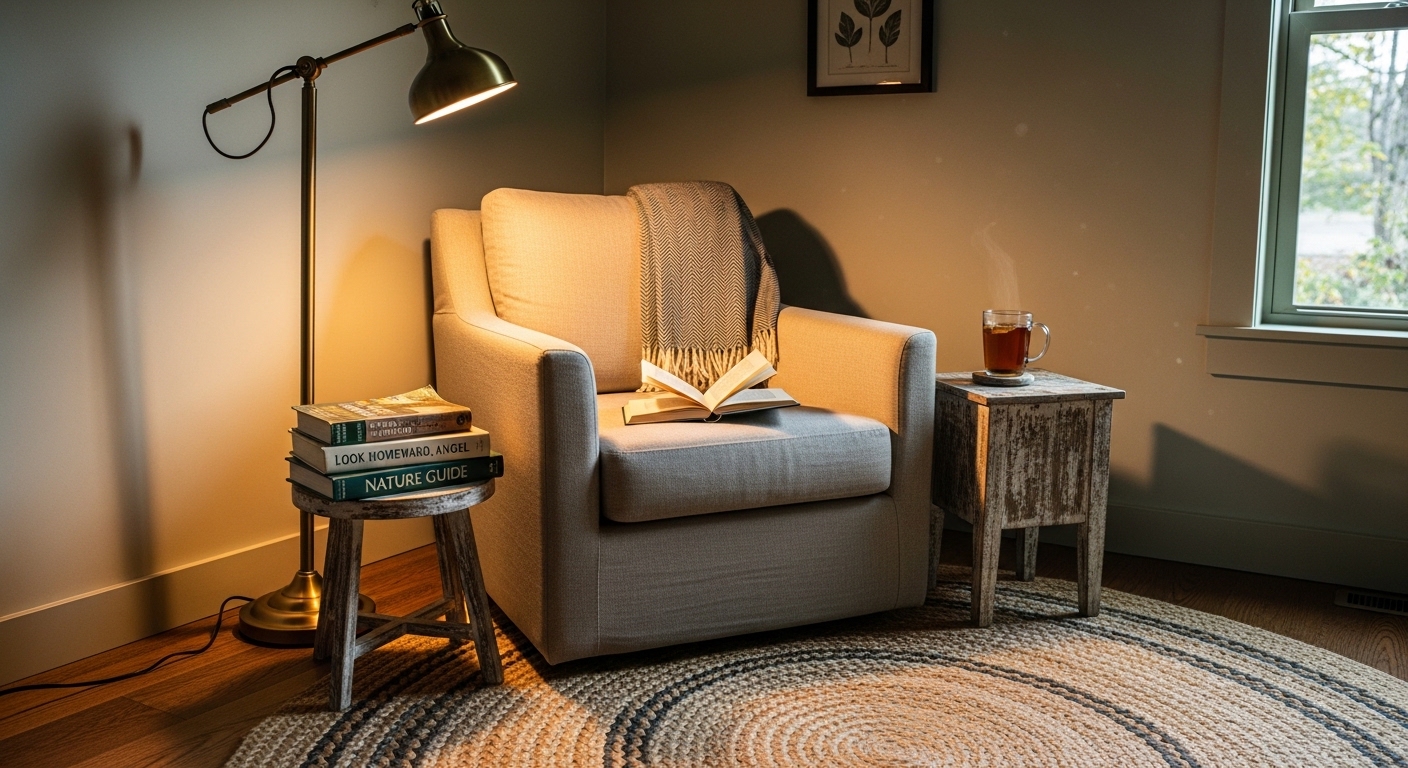
Cozy Atmosphere
A dimmer switch is the cheapest change that makes a home feel cozy, and installing one takes about twenty minutes once you've done the first: turn the breaker off, pull the old switch, match the wires (hot, load, ground, and sometimes neutral), screw the dimmer in, turn the breaker back on. Buy a dimmer rated for LED bulbs, check the bulbs are dimmable, and if the switch controls the light from two places you need a three-way dimmer. That's the whole method, and the rest of this post is the detail: which dimmer for which bulb, the wiring step by step, the three-way and smart versions, the flicker and buzz problems and their fixes, the settings I use at each hour of the evening in our Asheville cottage, and why it took a plumber to tell me what my rooms were missing. I spent the better part of three years shopping my way toward a cozy home, new lamps, new fixtures, new bulbs, and had a wall sconce I loved that still left the room flat at 7 pm. A plumber came to fix a leak, saw me frowning at the light, said "put dimmers on everything," and left. I did nine of them the next Saturday for about $90 in switches, and it was the most dramatic thing I'd done to the house that year.
Atmosphere isn't about the fixture; it's about the level. A lovely sconce at full brightness is a light source. The same sconce at 25 percent is a mood, because your eyes adjust, the shadows come back, and the room stops being lit like a shop. Every fixture you own has two rooms inside it, the bright one and the dim one, and without a dimmer you only ever see the first. I had bought three new lamps and a pendant before I understood this. All four were fine at full and better at 30 percent, and none of them needed replacing. If you can make one change to a home this season, make it dimmers, and make it before you buy any new light, because you may discover that what you have, at the right level, was what you wanted.
Three things decide it. First, the bulb type: for LED bulbs you need a dimmer marked "LED" or "CL" (compatible with LED and CFL), because the old incandescent-only dimmers make LEDs flicker, buzz, or refuse to go low; a leading-edge dimmer is fine for most LEDs and a trailing-edge dimmer is gentler on the cheap ones. Second, the wattage: add up the bulbs on the circuit; a standard dimmer handles 150 watts of LED, which is 20 or more bulbs, so this only matters for a big chandelier. Third, the switch layout: a single-pole dimmer if one switch controls the light, a three-way dimmer if two switches do, and only one of the two needs to be the dimmer. The styles, slide, rotary knob, paddle with a small slider, toggle, are personal; I chose paddles with a slider because they read as a normal switch to guests and the slider stays where I left it. Prices run about $10 for a basic LED slide dimmer to $25 for a good paddle to $50 for a smart dimmer, and the $25 ones have been the sweet spot in this house. The bulbs also have to say "dimmable" on the box; a non-dimmable LED on a dimmer flickers, hums, and dies early.
Turn off the breaker for the room at the panel, not just the switch, and test that the light is dead by flipping the switch. Unscrew the cover plate and the two screws holding the switch in the box, and pull the switch out gently to see the wires. On a single-pole switch you'll see two black (or one black and one red) wires on the brass screws, a bare or green ground wire, and, in newer houses, a white neutral bundled in the back of the box. Photograph it before you touch anything. Disconnect the old switch. The dimmer has its own short leads: connect one black lead to each of the two wires that were on the old switch (on a single-pole dimmer it doesn't matter which), the green lead to ground, and, if your dimmer has a white neutral lead, to the neutral bundle; cap each connection with a wire nut and give each a tug. Fold the wires into the box, screw the dimmer in, fit the cover plate, turn the breaker on, and slide. It took me forty minutes for the first one and about twelve for the ninth. Two cautions: a metal box needs the ground pigtail, and if the wires are aluminum instead of copper, or there are more wires than the picture, stop and call an electrician, which is what I'd do anyway in a house older than 1960 with cloth-wrapped wiring.
Our hallway light is on two switches, one at each end, and the first dimmer I bought for it was a single-pole. It worked from one end and made the other switch do nothing, which my husband reported. A three-way dimmer has an extra red "traveler" lead: it goes in place of the switch that has three wires plus ground, the common (usually on a black or darker screw) goes to the dimmer's black lead, the two travelers to the red leads, and the other switch stays a plain three-way switch. Only one dimmer per pair. The hall now dims from the kitchen end and toggles from the bedroom end, and there are "companion" dimmers that let both ends dim if you want that, at about twice the cost. The bedroom and living room are single-pole and were easy; the hall was the one that needed the second trip to the store.
A smart dimmer wires in the same way, usually needs a neutral, and adds a schedule and a phone app. I have two: one on the porch sconces, which come on at 40 percent an hour before dusk and go off at midnight without my doing anything, and one on the living room sconces, which drop to 20 percent at 9 pm because that's when we stop doing anything and start reading. Everything else is a plain slider, because I like turning a knob and because a $50 switch to dim a $40 lamp felt backwards. The rule I'd give: a smart dimmer where a schedule saves you a daily chore (porch, hallway, the lamp you always forget), a plain one everywhere you're in the room when you want it to change. Plug-in dimmers, the little $12 inline ones, do the same job for lamps without touching a wall, and every lamp in this cottage has one; renters can do the whole house that way.
Flicker at the bottom of the range almost always means the dimmer and the bulb don't like each other: try a different brand of bulb before a different dimmer, because bulbs are $3. Buzz from the switch means an incandescent-only dimmer on LEDs, or a very cheap LED; replace whichever is cheaper. A bulb that won't dim below 30 percent is usually the dimmer's minimum setting, and most LED dimmers have a small adjustment screw or a programming mode for the low end; ten minutes with the instructions fixed our bedroom. A bulb that flashes when off means a smart dimmer drawing a trickle of power through a bulb that's too small a load; add a second bulb or a "bypass" resistor, $8. And "dim to warm" bulbs, which go amber as they dim, need a dimmer that goes smoothly low; they're the nicest thing in the house and worth a good switch.
Morning coffee: 60 percent on the kitchen pendants, nothing else on. Cooking dinner: full brightness where I need to see the knife, the under-cabinet strips on their own switch. Dinner: the pendant over the table at 40, the kitchen at 20. After dinner: everything at 30 percent and the overhead off entirely; the living room sconces at 30, the arc lamp at 40, and the room is a different place with no furniture moved. Reading, 9 pm: the sconce beside my chair at 50 and everything else at 20. Bed: the bedside sconces at 25 on my side and 60 on my husband's, which is the entire argument for two dimmers instead of one. Guests: whatever it was, plus 10 percent, because people who don't live here need a little more light to feel at ease, and I've learned not to be precious about it.
Lamps take a plug-in dimmer or a dimmer on the cord, and the bulb has to be dimmable; that's the whole story, $12 a lamp. Pendants and chandeliers dim from the wall switch like any fixture, but add up the bulbs on a chandelier and check the dimmer's LED wattage rating. LED strips under the cabinets don't dim from a wall dimmer: they have a low-voltage driver, and the driver has to be a dimmable one, either with its own inline controller or a "0-10V" or "TRIAC" driver that a compatible wall dimmer can control. Ours were replaced with a dimmable driver for $30 and the strips now drop to 10 percent for the last dish. Ceiling fans with a light need a fan-rated control, not a lamp dimmer, or the motor hums. And integrated LED fixtures, the ones without a replaceable bulb, dim only if the box says so; a few cheap ones don't, and no switch will change that.
Living room first, because it's where the evening happens and where flat light shows most. Then the bedroom, where a dimmer on the overhead turns it from a searchlight into something you can wake up under. Then the dining table pendant, which at full is an interrogation and at 40 is a dinner. Then the kitchen, the hall, the bathroom, in that order. The one place I didn't dim is the laundry room, which wants to be bright. Nine dimmers, and I'd add them in exactly that order again. A $25 dimmer on the living room sconces did more for this house than the $300 sconces themselves, and I say that as someone who loves those sconces.
Nine switches at $8 to $25, about $90 in 2023 prices for the plain ones, plus two smart dimmers later at $48 each, and a $12 plug-in dimmer on each of six lamps. Around $260 for the whole cottage over a year, and four hours of work the first Saturday. What it saved is harder to count: the three lamps I would have bought that year, at least, and the arc lamp I'd been about to replace because it was "too bright," which at 40 percent is the best light in the house. Dimmed LEDs also draw less power, which is a small thing, and last longer, which is a real one; not a bulb has died in the living room since.
Install one dimmer, on the living room, and at 8 pm tonight turn the overhead off and take the sconces or the lamp to 30 percent. Wait five minutes for your eyes. Then look at the room. If it's the room you've been trying to buy, you can stop shopping, which is what happened to me, and the plumber, who I never saw again, is the reason this blog is about light at all. Everything else on this site, the bulb test, the candlelit setting, the bedroom layers, sits on top of the dimmers. They're the foundation, and they cost less than dinner out.
Shop this post: wall sconces and plug-in wall sconces, all dimmable with the bulb included