Room by Room
The best reading nook ideas are mostly subtraction: a seat you can sit in sideways, a light that comes over your shoulder, a place to put a cup, and nothing else. Ours is a window seat in an alcove off the library, five feet wide, with a faded French blue linen cushion, a small brass plug-in sconce at 62 inches on the left wall, a view of mountain and tree, and, since last winter, one ceramic hook for a blanket. That's the whole nook, and I use it every day. It nearly became a project instead. I had a list: a floating shelf for tea, a plant in the corner, a wool throw in a complementary color, a second pillow in a different texture, and I kept adding to the list and not finishing the nook because I couldn't find quite the right things. Then the sconce went up, I sat down with a book to test the light, and the nook was done. This post is what a reading nook needs and doesn't, the seat options from window seat to closet to corner chair, the light and its height, the ten nook ideas I've seen work in other houses, the small-space and rental versions, what ours cost, and the list of things I planned and never added.
Three things. A seat that supports your back and lets you tuck your feet up, which means a depth of at least 20 inches and a back or a wall to lean on. Light that lands on the page from above and behind one shoulder, 400 to 500 lumens, warm, on a dimmer or with a switch you reach without getting up. And a surface within arm's reach for the cup, the size of a saucer, no bigger. A reader needs light, a comfortable place to sit, and as few distractions as possible. Everything on my original list was a distraction. Good reading nooks are built by taking things away until only the reading is left.
A window seat is the classic and the best if you have one: the wall behind, the window beside, the daylight for the afternoon and the sconce for the evening. Ours is a built-in bench, 20 inches deep and 18 high, with a 4-inch cushion; deeper than 24 inches and you can't lean back, shallower than 18 and you can't tuck your feet. No window seat? A single armchair pulled into a corner, angled so the wall is behind you and the light beside, with a small stool for your feet, is a nook, and it's what the guest room has. An unused closet with the doors off, a cushion on a platform and a sconce inside, is a nook, and my daughter made one in her first apartment for about $90. The landing at the top of the stairs, a bay window, the end of a hallway with a bench: any place with a wall behind you and a light beside you. What doesn't work is the middle of a room, because a reading nook is about having your back to something.
The cushion is a 4-inch foam with a linen cover, in a color that's already a little faded because a reading cushion will fade anyway; ours is French blue, worn at the front edge, and the wear is part of why it looks like a place someone sits. One cushion, not a pile of pillows, and one back pillow if the wall is hard. The blanket hangs on a hook beside the sconce, a lightweight wool in winter and nothing in summer, and the hook was the one addition I made after the nook was "done." It cost $8 and it means the blanket has a home that isn't the seat.
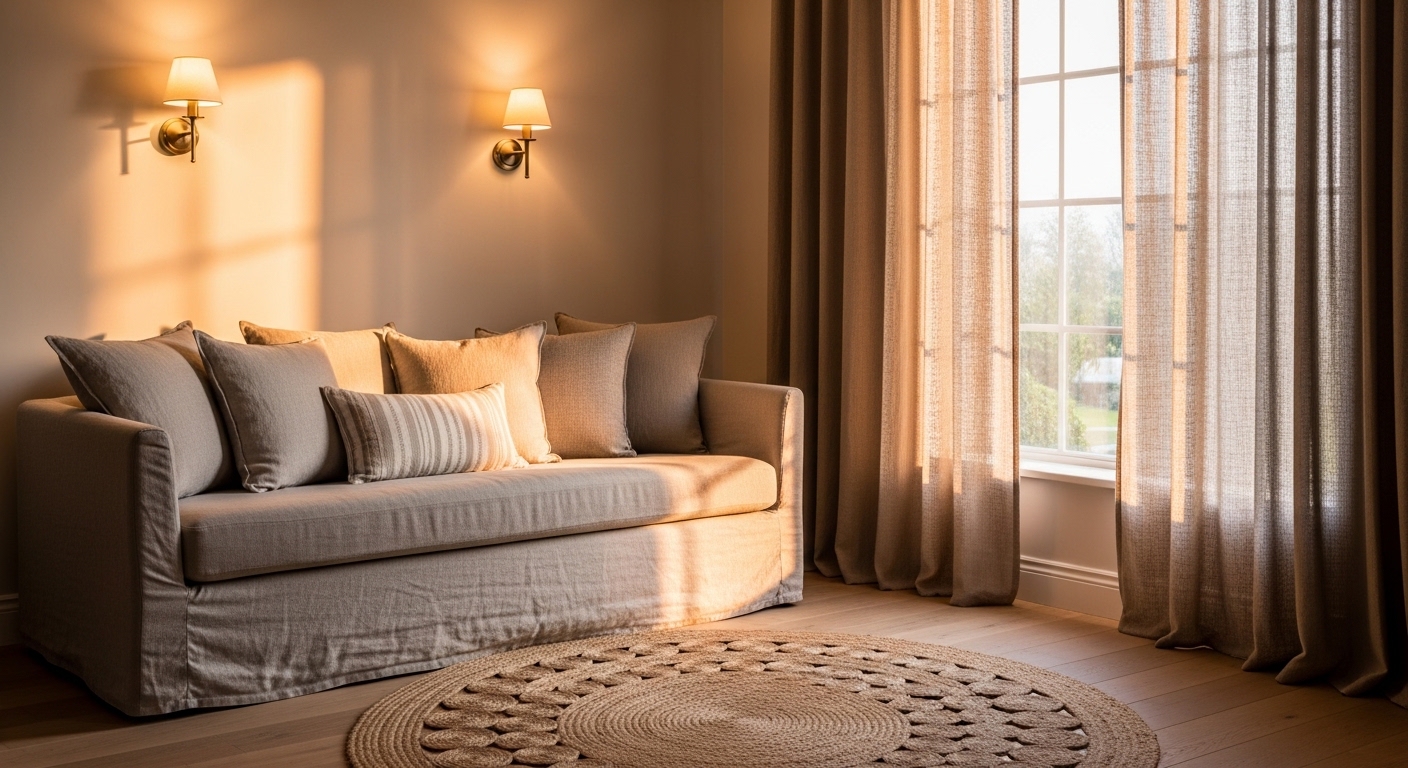
A wall sconce mounted at 60 to 64 inches on the wall beside the seat, on the side of your reading hand's opposite shoulder, with a shade that sends the light down; ours is a small brass plug-in sconce with a linen shade at 62 inches on the left, and the cord runs down the alcove corner in a paintable channel. A 450-lumen 2700K bulb, on a plug-in dimmer, full for reading and 30 percent for sitting with tea. If the nook is under a ceiling, a small pendant hung with its bottom at 60 to 66 inches from the floor does the same job, and the pendant height post has that version and the bare-bulb mistake I made first. A floor lamp beside a chair works if the shade is closed at the top and the bottom edge is at your seated eye level. What doesn't work: an overhead light, which lights the room and puts your own head's shadow on the page, and a lamp on the opposite side from the wall, which is why a nook is a corner.
A nook by a window gets two lights, the day and the sconce, and the window should be beside you, not behind or in front. Behind you it glares off the page; in front it's a black rectangle at night and a distraction by day. Beside you, on the side opposite the sconce, the daylight does the reading until about four in winter and the sconce takes over without your noticing the handoff. North light is the reader's light, even and cool all day; a west window means an hour of squinting at five, and a sheer linen panel fixes it. Ours faces east, so the nook is a morning place with coffee and an evening place with the sconce, and the middle of the day belongs to the porch.
Two readers need two lights, one per shoulder, and a bench at least 5 feet long, or two chairs at an angle with a table between; sharing a light means one of you is in the other's shadow. For a child, the nook is a low platform or a floor cushion in a corner with a rechargeable sconce at their seated shoulder height, about 36 inches, on a timer that dims at bedtime, and a bin for the books within reach. My son's was a closet nook with a beanbag and a clip light, and it lasted from six to twelve. The rule is the same at every age: a wall behind, a light beside, and nothing to do but read.
A window seat with drawers under it, which is where the winter blankets live. A deep armchair in a bedroom corner with a swing-arm sconce, the guest room version. A daybed under a window with two pillows and a plug-in sconce, the nook that doubles as a spare bed. A closet with the doors off and a cushion on a raised floor. A landing bench under a stair window. A bay window with a cushion cut to the angle. A chair beside the fireplace with the mantel sconce as the light, which is the living room nook on winter nights. A bunk-style alcove in a child's room with a rechargeable sconce on a timer. A porch corner with a wicker chair and an outdoor sconce, which is where I read from May to September. And the plainest: a chair, a lamp, a wall, which is the one that fits every house. What all ten have in common is a wall at your back, a light at your shoulder, and not much else.
A reading nook takes 3 by 4 feet. In a studio it's an armchair angled into the corner behind the sofa with a plug-in sconce on strips and a stool; in a rental with no corners it's the end of the bed with the headboard behind you and a rechargeable sconce on the wall. The light is the only thing that has to be right, and a rechargeable sconce with no cord makes any wall a nook wall for $60. The lamp versus sconce post covers the choice; in a rental I'd go plug-in or rechargeable and put the cushion money into the cushion.
The floating shelf for tea, because a saucer-sized sill was already there. The plant, because a plant in a nook is a thing to water and a thing to look at, and a nook is for looking at a page. The throw in a complementary color, because the blanket on the hook is the throw. The second pillow, because two pillows on an 18-inch bench leave nowhere to sit. The framed print for the back wall, because the view is out the window. Every one of these was a decorating impulse, not a reading impulse, and the absence of all of them is why the nook works. If you find yourself making a list for a reading nook, stop at three items.
The threat to a reading nook isn't the building; it's the month after, when the seat becomes the place the laundry basket goes and the sill becomes where the mail lands. Two rules keep ours a nook. Nothing is stored on it, ever, including books, which go back to the shelf or stay in the one stack on the floor beside the seat, never more than three. And it's the first thing I clear when I tidy, because a nook with a basket on it is a bench. The hook helped more than I expected: the blanket has a place, so it isn't the thing that's always on the seat. A nook that stays empty is a nook you'll sit in, and a nook you sit in stays empty.
The built-in bench came with the house. The foam and linen cover, $85. The plug-in sconce, $58. The bulb and plug-in dimmer, $18. The hook, $8. The blanket, an old one. About $170 for the nook, and the sconce was the only decision that mattered. The guest room version, a chair, a stool, a swing-arm sconce and a side table, was about $520 with a secondhand chair, and it's in the guest room post.
Eighteen inches from the floor to the top of the cushion, the same as a dining chair, is the height at which your feet reach the floor and you can also tuck them up; a 14-inch bench is a child's, and a 22-inch one leaves your legs dangling. If a built-in bench is too low, a thicker cushion fixes it; too high, and a footstool does. The depth, 20 to 24 inches, is the other number, and together they decide whether the nook is somewhere you sit for an hour or somewhere you perch. Measure the bench before the cushion, because the cushion is the easy thing to change and the bench isn't.
2700K, CRI 90, 450 lumens, dimmable, E26, frosted or behind a shade, and a warm-dimming bulb if the nook doubles as a place to sit with tea in the dark. Nothing cooler than 3000K, even for small print; if the print is small, add lumens, not Kelvin. The bulb test has the brands that were honest about the numbers.
Because it's almost bare. The cushion, the sconce, the window, the hook. The view is mountain and tree, the wall is white, the light is small and brass and not trying to be noticed, and there's nowhere to put anything, so nothing accumulates. I sit sideways with my back to the wall and my feet up, the sconce over my left shoulder, and read for twenty minutes or two hours, most days, in a corner that nearly became a project and instead became the most used three square feet in the house.
Shop this post: plug-in wall sconces and rechargeable wall sconces for nooks without an outlet